** Due to a substantial rise in demand as well as budget constraints and staff limitations, the ASU Meteorite Identification Program was suspended in 2010**
The Buseck Center for Meteorite Studies is in no way responsible for any specimens sent to the Center, nor is the Center responsible for returning them to senders.
To learn if you have a meteorite…
Use the links in the “Meteorites” drop-down menu to learn more about meteorites and compare your possible meteorite to real specimens.
You can also take this quiz:
Is the specimen black or brown and smooth, with no holes or bubbles on the surface?
Is the specimen solid and compact?
Is the specimen heavy compared to a “normal” rock of the same size?
Does a magnet stick to the surface of the specimen?
Is the specimen entirely made of metal, or does it show metallic specks on all parts of a broken, cut, or polished surface?
If you answered “no” to any of these questions, you probably don’t have a meteorite…
Because your specimen does not have the most common characteristics of a meteorite, it is likely a terrestrial rock. Terrestrial rocks that are mistaken for meteorites are called “meteorwrongs”.
What do I do now?
We encourage you to contact your State Geological Survey office, the Geology department of a local university or college, or your local museum of natural history for help identifying your specimen.
For information on common meteorwrongs, read on!
Meteorwrongs
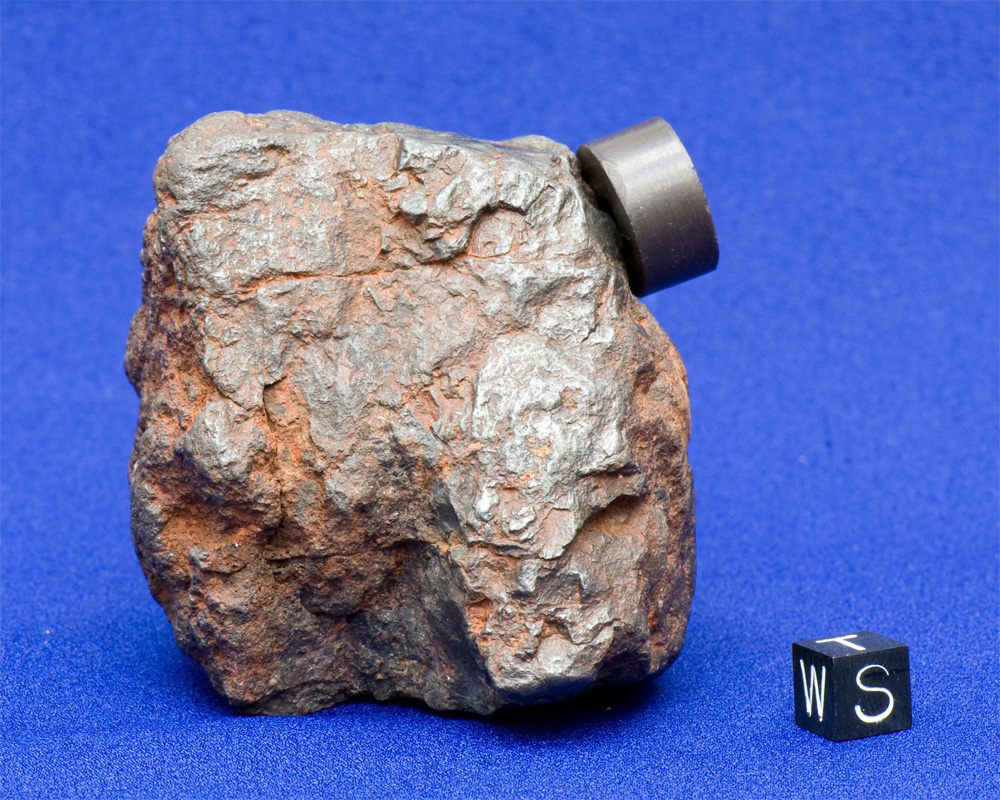
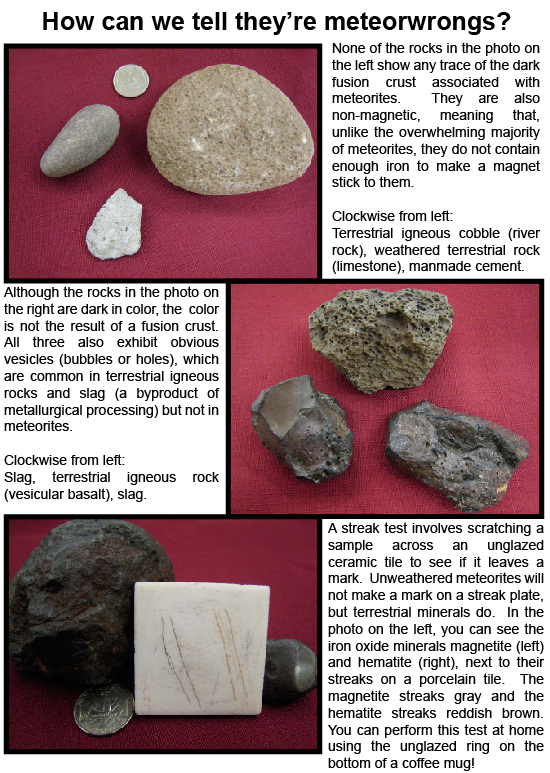
Two common meteorwrongs are the iron oxide minerals hematite (Fe2O3) and magnetite (Fe3O4), example pictured below.
Most minerals leave a characteristic colored streak when scraped along the unglazed surface of a ceramic tile or coffee mug. You can do this test at home, using the ceramic ring on the bottom of a coffee cup, but be careful to not break the cup!
Hematite leaves a red-brown streak and magnetite leaves a gray-black streak. Other minerals may leave brown, black, green-black, gray, or even yellow streaks.
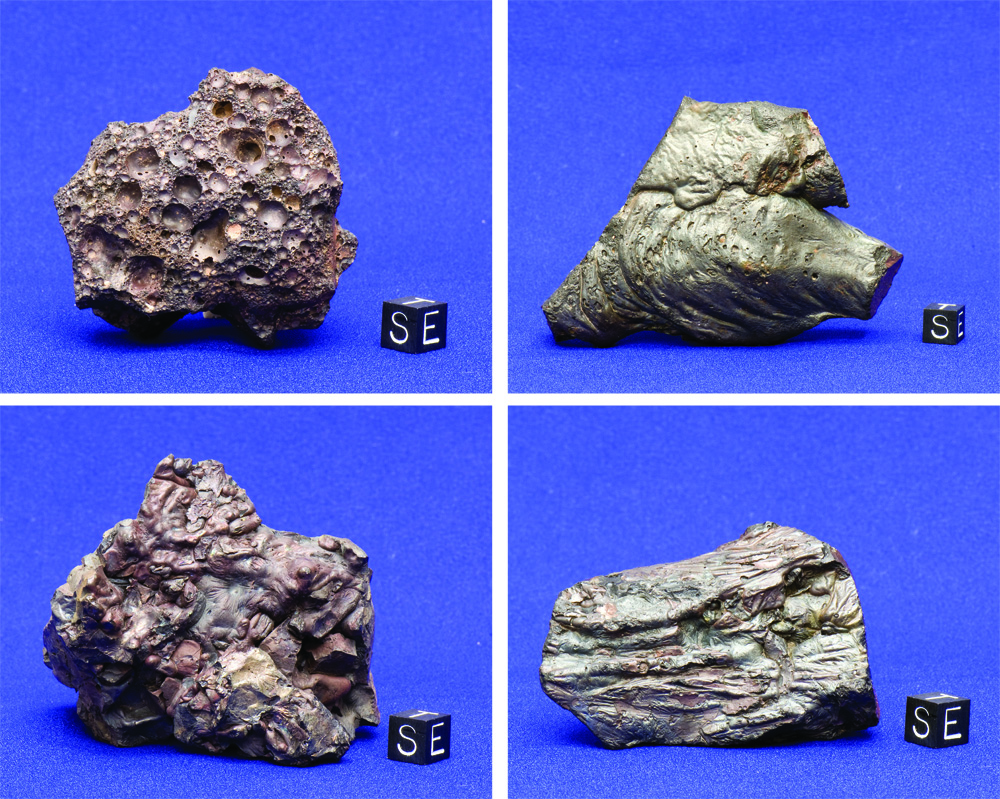
If your specimen does not leave a streak, you may have a piece of slag: a man-made industrial byproduct of the mining and metallurgy industries.
Slag (photos of examples above) is often made up of metal, sometimes combined with metal oxides and/or sulfides, and many additional components (silica, calcium, etc.). Slag is often magnetic, and may appear similar to some meteorites, so be wary of this meteorite impostor! It can be found almost anywhere, even in what might be considered “the middle of nowhere”, because slag is commonly used for fill in roads or train tracks.
While your specimen may show some of the common characteristics of a meteorite, online testing alone cannot conclusively identify it as a meteorite.
What do I do now?
Do not send your specimen to the Center.
Due to a substantial rise in demand, as well as budget constraints and staff limitations, the public Meteorite Identification Program hosted by the ASU Buseck Center for Meteorite Studies was suspended in 2010.
Specimens sent to the Identification Program are no longer accepted.
The Buseck Center for Meteorite Studies is in no way responsible for any specimens sent to the Center, nor is the Center responsible for returning them to senders.
We encourage you to contact your State Geological Survey office, the Geology department of a local university or college, or your local museum of natural history for help identifying your specimen.
Need more information?
Please refer to our FAQ section for a list of Frequently Asked Questions.