About Peter Buseck
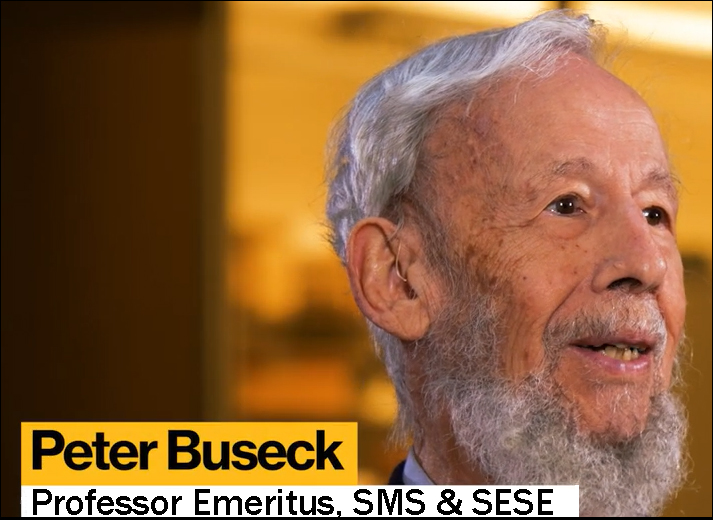
Professor Peter Buseck is renowned for his pioneering use of high-resolution transmission electron microscopy (HRTEM) in the study of study meteorites and mineral structures. His analyses of crystals lattices and defects at the atomic scale transformed our understanding of solid-state geochemistry and cosmochemistry. He joined the ASU faculty in 1963, drawn by the opportunity to work with the meteorites in the newly founded Center for Meteorite Studies. For over 60 years (1963-2023), he served as an active member of the ASU faculty. As Professor Emeritus, he continues to champion meteoritics research in both professional and public forums. His research contributions span diverse mineralogical samples, including carbonaceous chondrites, pallasites, and Martian meteorites, as well interplanetary dust particles and terrestrial aerosols.
The definitive research to determine the matrix mineralogy of carbonaceous chondrites was accomplished by Tomeoka and Buseck’s use of high-resolution transmission electron microscopy (HRTEM) (1,2). Buseck’s next most cited paper related to meteorites was in Science about carbyne (3), which also led to a series of papers, the most recent of which appeared in 2025.
The Buseck team performed the first HRTEM studies of interplanetary dust particles (4, 5) as well as a series of papers on magnetotactic bacteria relevant to the reported meteorite evidence of life on Mars (6, 7). Significant “firsts” in Buseck’s other areas of study are on atmospheric aerosol particles and their effects on climate (8), the pioneering use of HRTEM to study mineral structures and defects at the sub-unit-cell scale in silicates (9, 10), sulfides (11), and oxides (12), as well as solid-state mineral reaction mechanisms (13). Other relevant papers are on fullerenes (14) and Fe-Mg diffusion (15). Buseck and his team had a total of 40 papers (6 covers) published in Science, Nature, and Proceedings of the National Academy of Sciences.
(3) Carbyne forms of carbon: Do they exist? P.P.K. Smith and P.R. Buseck, Science 216, 984–986, 1982.
(10) Asbestiform chain silicates: New minerals and structural groups, D.R. Veblen, P.R. Buseck, and C.W. Burnham, Science 198, 359–365 & cover photograph, 1977.
(12) Todorokites: A new family of naturally occurring manganese oxides, S. Turner and P.R. Buseck, Science 212, 1024–1027 & cover photograph, 1981.


